How To Sell A Dental Practice Confidentially

Table of Contents
When a dental practice goes to market, the seller does not stop practicing. The doors stay open. Staff show up. Patients are seen. The business continues exactly as it always has, while a transaction quietly moves forward in the background.
That is what makes confidentiality in a dental practice sale more consequential than it might first appear. The practice being sold is also the practice that has to keep performing. Its value depends on staff who do not yet know about the sale and patients who have no reason to question whether their care is about to change. As long as the process stays controlled, both of those conditions hold. When it does not, the situation can change very quickly.
Real Scenario
In one transaction, a practice sale leaked roughly three weeks before closing. Four of the six staff members gave notice. The buyer backed out, deciding they did not want to begin ownership with a destabilized team and an immediate hiring problem.
That is why confidential selling depends on controlling disclosure in a way that allows the right buyers to move forward while the business stays stable.
Confidentiality As Value Protection In A Dental Practice Sale
Most owners think about confidentiality in personal or reputational terms first. They do not want staff, patients, or competitors hearing that they are exploring a sale before they know exactly what is happening. That instinct is valid, but it is only part of the story.
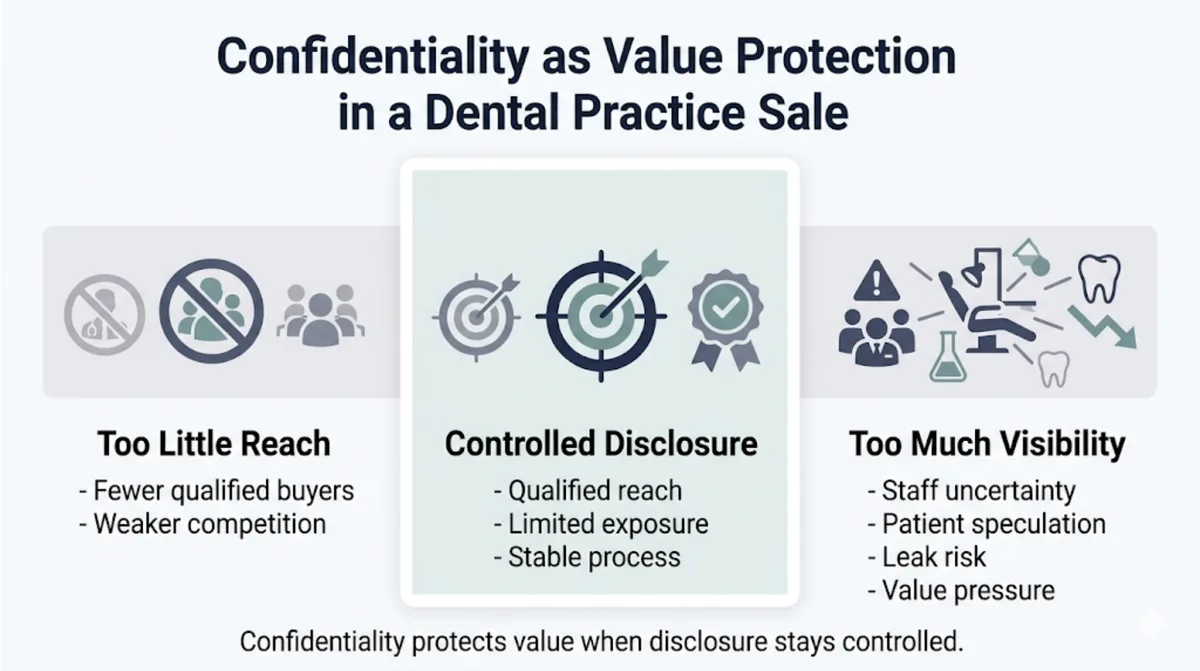
Confidentiality matters because practice value depends on continuity, trust, and control. If staff hear about a possible sale too early, they may start to question their future, change their behavior, or look for other opportunities. If patients catch fragments of the story before there is a clear transition plan, they may begin to wonder whether their care will change. If either of those reactions affects daily operations, buyers will treat it as a business risk.
That risk has a practical sequence. Staff instability disrupts operations. Operational disruption affects the patient experience and day-to-day production. If production softens, revenue follows. And once revenue or stability comes under pressure during a live process, buyers and lenders begin to question value, certainty, and whether the deal should proceed on the same terms.
This is where sellers need to strike a careful balance between reach and visibility.
Reach vs. Visibility
Reach means getting the opportunity in front of qualified, relevant buyers. Visibility means the practice is exposed broadly enough that people who should not know about the sale begin to recognize it or talk about it. Sellers need the first. Too much of the second weakens the practice before the seller has the protection of a closed deal.
The real goal is controlled disclosure. The process should allow serious buyers to assess fit and move forward without creating unnecessary exposure for the practice itself.
What Confidentiality Actually Requires In A Dental Practice Sale
When a seller says they want the sale handled confidentially, that should mean something concrete: who knows what, when, and under what conditions.
In practice, confidentiality is a system with multiple steps. It starts with anonymous marketing. Early visibility should be broad enough to reach relevant buyers without making the practice immediately identifiable. From there, access should expand only as the buyer demonstrates more seriousness and the process becomes more real.
That system usually includes:
This is why qualification and confidentiality are inseparable. A signed NDA matters, but it does not solve everything. Anyone can sign an NDA, including buyers who are curious, misaligned, or not truly capable of transacting. An NDA creates a framework for confidentiality. Sellers still need to decide who should receive information in the first place.
A strong process also makes access manageable after information is shared. The seller should know exactly who has seen what, and the process should allow access to be restricted or removed when a buyer stops progressing.
That distinction is critical because confidentiality problems usually begin after sellers treat "signed NDA" as a reason to share everything. A stronger process uses the NDA as a gate for controlled sharing, not as permission for full access.
Key Insight Confidentiality means controlling the flow of information from first view to final close.
Common Ways Confidentiality Breaks Down In A Dental Practice Sale
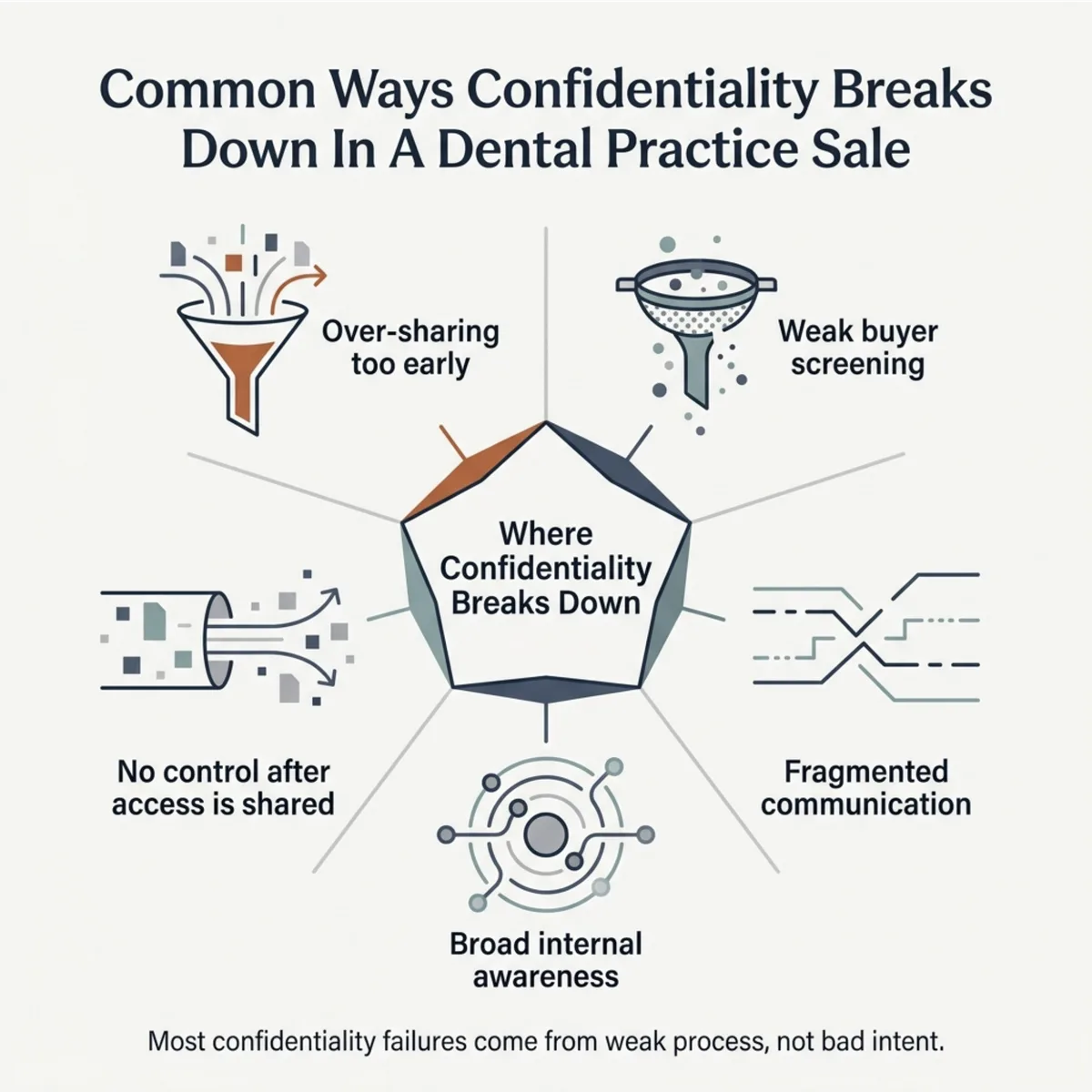
Most confidentiality failures do not come from malicious intent. They come from weak process.
Over-Sharing Too Early
Sellers sometimes assume that giving buyers more information upfront will create momentum. In reality, early-stage buyers usually need only enough detail to evaluate fit. Once sensitive information is shared too widely, it cannot be pulled back, even if those buyers never move forward.
Weak Buyer Screening
Interest and seriousness are very different things. When sellers treat every inquiry as equally important, they allow unqualified buyers into a process that should stay narrow and controlled. That increases leak risk without improving the quality of the buyer pool.
Fragmented Communication
If sellers, brokers, and buyers are all communicating loosely across multiple channels, inconsistencies emerge. Documents get forwarded. Details get repeated without context. There is no clear record of who knows what. Even if each individual interaction seems harmless, the combined effect is loss of control.
Broad Internal Awareness
Dental practices are tight-knit environments, and information travels quickly through informal conversations. A seller may mention a possible sale to one trusted person, intending to be thoughtful or transparent. Within days, the office may be speculating about what is happening. Once that starts, it is very difficult to contain.
No Control After Access Is Shared
A weak process often has no clear way to track who has received sensitive data or to restrict access later if a buyer loses interest. That leaves former buyers holding information they no longer need, and the seller loses visibility into where exposure might continue.
The pattern across all of these failures is the same: the seller gives away control before there is enough buyer commitment to justify it.
How Staged Disclosure Works In A Confidential Dental Practice Sale
The strongest principle for staged disclosure is simple: only share the next level of information once the buyer has taken the next level of commitment. It protects both value and momentum. Serious buyers will engage with staged information. Unqualified buyers tend to consume everything and disappear.
Before The Practice Is Identified
Sellers can safely share high-level, non-identifying information that lets buyers judge fit. That usually includes the general region or metro area, approximate revenue, number of operatories, specialty, and a short description of the opportunity. At this stage, the objective is to provide enough clarity for the right buyer to lean in.
Once Qualified And Under NDA
The next layer can open. This is where a practice profile becomes useful. The buyer may see more detailed summary information such as exact location, office hours, general staff structure, procedures being referred out, and summary-level financials. In some cases, this stage may also include limited historical financial information that helps the buyer begin early conversations with a lender or CPA.
What should still remain controlled at this stage is anything that goes beyond serious evaluation and into full verification. Detailed production reports, full internal operating detail, and deeper diligence materials do not need to open just because an NDA has been signed.
Once An LOI Is Signed
The process changes. At that point, the buyer is no longer deciding whether they are interested. They are verifying that the deal works. That is when deeper information becomes appropriate: detailed production and collections reports, fee schedules, insurance breakdowns, full financial statements, and the supporting documentation needed to confirm the business as presented.
Key Insight A good process does not trade disclosure for progress. It ties disclosure to commitment.
How Timing Affects Confidentiality In A Dental Practice Sale
Confidentiality depends on both what gets shared and when key events happen.
Office tours and buyer meetings are a good example. These moments carry confidentiality risk because they move the process from reviewing information to interacting with a live business. A tour should happen only after the buyer has signed an NDA, reviewed the practice profile, and shown enough seriousness that an in-person meeting helps determine whether real commitment is forming.
The sequencing matters. A buyer should not be signing an LOI before visiting the practice and meeting the seller. The visit is part of forming a real commitment, not something that happens after it. At the same time, tours should not happen too early or too often, because each one increases exposure.
Staff disclosure is another timing decision sellers often get wrong. In most cases, staff should be informed at or after closing, once the transaction is certain and the transition message is clear. The most common situation where sellers feel they need staff help is pulling reports from their practice management system during diligence. In most cases, this can be handled without involving anyone at the office at all. A quick Google search will direct you to the right reports without creating any internal awareness.
Involving a trusted team member should be treated as a last resort. If that becomes necessary, the goal is still to keep exposure as narrow as possible and to frame the request around a general business need rather than a pending sale.
Patient communication belongs even later. Patients should hear about the transition when there is full certainty, a known buyer, and a coordinated message. In many successful transitions, the seller communicates first, reassuring patients that the buyer has been selected carefully and expressing confidence in the next owner. The buyer's introduction then follows. When that sequence happens after closing, the practice keeps control of the message. When patients hear about a possible sale too early, they are left to interpret incomplete facts on their own.
✓ Do
- ✓ Hold office tours after an NDA is signed and the buyer has been meaningfully screened
- ✓ Limit staff awareness until closing; treat any staff involvement during diligence as a last resort
- ✓ Tie deeper disclosure to concrete buyer commitment
- ✓ Keep a qualified process moving once the right buyer is engaged
✗ Avoid
- ✗ Scheduling tours too early or too often
- ✗ Creating broad internal awareness before the deal is real
- ✗ Sharing sensitive information because a buyer merely seems interested
- ✗ Letting the deal drag and extend the exposure window unnecessarily
The broad principle is simple: timing should be tied to certainty. Long windows of awareness without clear answers create instability. A well-run process minimizes that window.
What Strong Confidentiality Looks Like In A Dental Practice Sale
From the seller's point of view, a strong confidential process feels controlled rather than chaotic.
It starts with qualified reach. The opportunity is visible to the right buyers, but not broadly exposed. It moves through controlled access, where information is released in stages as buyers show fit and commitment. It uses disciplined timing, so office tours, staff awareness, and patient communication happen when they support the transaction rather than destabilize it. And it relies on coordinated communication, so there is one clear process instead of scattered interactions that are hard to track.
Good confidentiality does not necessarily slow a deal down. In many cases, it does the opposite. When information is organized, expectations are clear, and serious buyers know exactly what step comes next, the process moves more efficiently. That matters because speed, when paired with structure, shortens the window in which leaks can damage the business.
This is also where sellers often misunderstand the tradeoff between secrecy and momentum. The more common and damaging problem is losing control too early. Over-secrecy can slow a process if buyers cannot evaluate the opportunity. Under-control creates exposure without creating real progress.
The best confidential process protects value while still letting serious buyers move forward. It does not try to tell nobody anything. It makes sure the right people know the right things at the right time.
That is the final point sellers should understand. Confidentiality means controlling what gets shared, when, and with whom. When that control is preserved, the seller protects staff stability, patient confidence, business performance, and leverage all at once. That is what makes confidentiality a transaction issue rather than a courtesy issue.
The Bottom Line
Confidentiality means controlling what gets shared, when, and with whom. When that control is preserved, the seller protects staff stability, patient confidence, business performance, and leverage all at once. That is what makes confidentiality a transaction issue rather than a courtesy issue.
Ready to start a confidential process?
Get a free, transaction-focused estimate of your practice value — the first step in any well-structured, confidential sale process.
Value Your Practice
About the Author
Andrea Berk is an entrepreneur and business strategist specializing in dental practice growth, operations, and practice transitions. She is the Founder of The Dental Shop, where she works closely with dentists at every stage of their careers to help them make smarter decisions around buying, selling, scaling, and optimizing their practices. Andrea brings a practical, real-world perspective to complex business challenges facing dental professionals today. Her work focuses on helping practice owners increase efficiency, improve profitability, and build long-term enterprise value—without losing sight of patient care or work-life balance. Andrea regularly publishes insights on dental practice management, business strategy for dentists, practice transitions, and entrepreneurship, offering actionable guidance designed to help owners navigate growth with clarity and confidence. When she’s not advising practice owners, Andrea is focused on building scalable systems and partnerships that elevate independent dental practices nationwide.