Is Your Dental Practice Sale-Ready?

Table of Contents
A dental practice can be profitable, busy, and well-regarded in the community and still not be ready for a strong sale.
Many dental practice owners are caught off guard by this reality. A buyer expresses interest. A DSO reaches out. Revenue looks healthy. The office has been updated. On the surface, the practice appears highly sellable. Then the deal is tested. Financials do not reconcile cleanly. The lease creates uncertainty. A lender becomes hesitant. What looked like a straightforward sale starts to slow, weaken, or reprice.
Sale-readiness is not the same as profitability. It is not the same as buyer interest. And it is not the same as feeling personally ready to exit. A practice is truly sale-ready when a serious buyer and a lender can evaluate it with confidence and conclude that the business is likely to hold up through transition and close at the expected value.
Why a Profitable Dental Practice Is Not Always Sale-Ready
Profitability is internal performance. Sale-readiness is external credibility.
A profitable practice makes money. A sale-ready practice can prove that income in a way the market can validate, normalize, and finance. The distinction matters because a transaction does not run on what the owner knows to be true. It runs on what a third party can verify and underwrite.
Key Insight A practice can be marketable but not financeable.
Marketable means the story works. Buyers see an attractive location, healthy revenue, a strong patient base, or visible growth opportunity and want to learn more. To be financeable, however, the numbers should hold up, cash flow should be supportable, documentation should be consistent, and risk should be understandable. Only then does the deal work not just in theory, but in a form a lender will back.
In live transactions, the distinction between marketable and financeable becomes very real, very quickly. A practice may show $1.3 million in revenue and attract serious interest, but if lender review later finds that a meaningful share of earnings depends on unclear add-backs or income that cannot be cleanly supported, financing can weaken or disappear. The result is not always a failed deal. Often, it is a deal that no longer closes at the number the seller expected.
Financeability is the real readiness test. The question is not simply whether the practice is worth a certain number. It is whether the practice can actually close at that number.
Many owners begin evaluating a sale because something shifts personally. Retirement feels closer. Burnout becomes harder to ignore. The administrative burden starts to outweigh the upside of ownership. Those signals matter. But they do not answer the transaction question. Feeling ready to sell is often the moment to evaluate readiness, not automatically the moment to go to market.
A Sale-Ready Dental Practice: What Buyers and Lenders Test
When buyers evaluate a practice, they are not just interested in whether it looks successful today. They want to know whether performance is likely to continue after ownership changes.
The buyer-side lens usually centers on transferability. Buyers are typically asking:
-
Can a new owner step in and preserve production?
-
Are patient relationships tied only to the selling doctor, or to the practice more broadly?
-
Is the team stable enough to support continuity?
-
Are hygiene and recall systems strong enough that revenue feels recurring rather than fragile?
If production is heavily concentrated in procedures the buyer does not perform, or if the office runs more on personal habits than documented systems, buyer confidence drops.
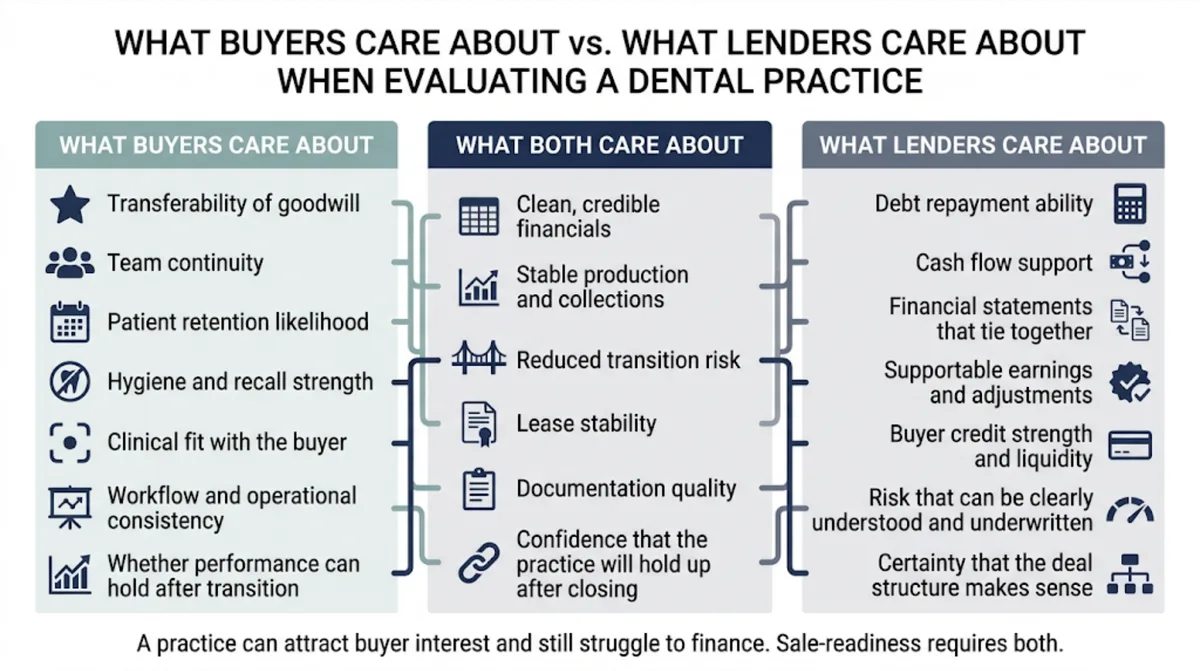
Lenders are testing something different, though related. Buyers test transferability. Lenders test certainty of repayment.
A lender is not trying to decide whether the practice is exciting. The lender is deciding whether the cash flow is reliable enough to support debt, compensate the buyer, and absorb normal variability without breaking the structure of the deal. That evaluation usually comes down to clean financials, reasonable adjustments, consistent reporting, and a practice story that makes sense without heavy explanation. It also includes whether the buyer can realistically sustain the production the practice generates. If a practice depends heavily on procedures the buyer does not perform, lenders see a real post-close revenue risk even if the historical numbers look strong.
This is where many deals start to weaken. A practice can look strong in conversation and still become harder to finance if:
- Profit and loss statements do not tie cleanly to tax returns
- Reporting periods shift between documents
- The explanation of earnings depends too heavily on adjustments or optimistic interpretations
Lenders do not get comfortable because a deal looks good. They get comfortable because it makes sense without explanation.
There are also shared friction points that matter to both buyers and lenders. Lease quality is a major one. A short remaining term, unclear extension options, or assignment restrictions can create real transaction risk even when financial performance is solid. Diligence-readiness matters too. If basic reports are hard to pull, supporting documents are scattered, or questions take too long to answer, confidence starts to erode before the parties even reach the harder parts of the process.
Common False Signs That a Dental Practice Is Ready to Sell
One of the most common false positives is unsolicited buyer interest.
An inbound call from a buyer or DSO signals interest in the practice. It may indicate attractive geography, appealing revenue, or strategic fit. But it does not prove that the practice is ready to transact cleanly or at the level the seller expects. Interest starts a conversation. It does not validate the numbers, the structure, or the ability to close.
Another common false positive is one strong year.
Buyers and lenders care more about patterns than spikes. A sharp jump in production or revenue can be encouraging, but it does not necessarily prove that performance is durable. It may reflect deferred treatment, a temporary procedure mix shift, or a short-term operating change that has not yet established itself as the new normal.
Example: A practice that moves from $1.1M to $1.15M to $1.2M is often treated as lower risk than one that sits at $1.0M for two years and then jumps to $1.3M. The first pattern suggests stability. The second invites questions about whether the new level is truly repeatable.
Strong production can also create false confidence when it masks transfer risk. In dental, it is normal for the owner to produce a large share of revenue. What matters is whether that production will hold after the owner leaves.
If patients are tied primarily to the seller, if high-value procedures depend on the seller's specific skill set, or if the practice lacks the systems that make revenue repeatable, strong production may attract buyer interest without proving that the same performance will continue after the transition.
Key Insight Production creates interest. Transferability creates confidence.
Cosmetic upgrades and new equipment belong in this category as well. They can improve first impressions and make a practice easier to market, but they do not resolve weak reporting, unstable cash flow, or uncertain transferability. They support the story. They do not replace it.
The Evidence: What Buyers and Lenders Look For
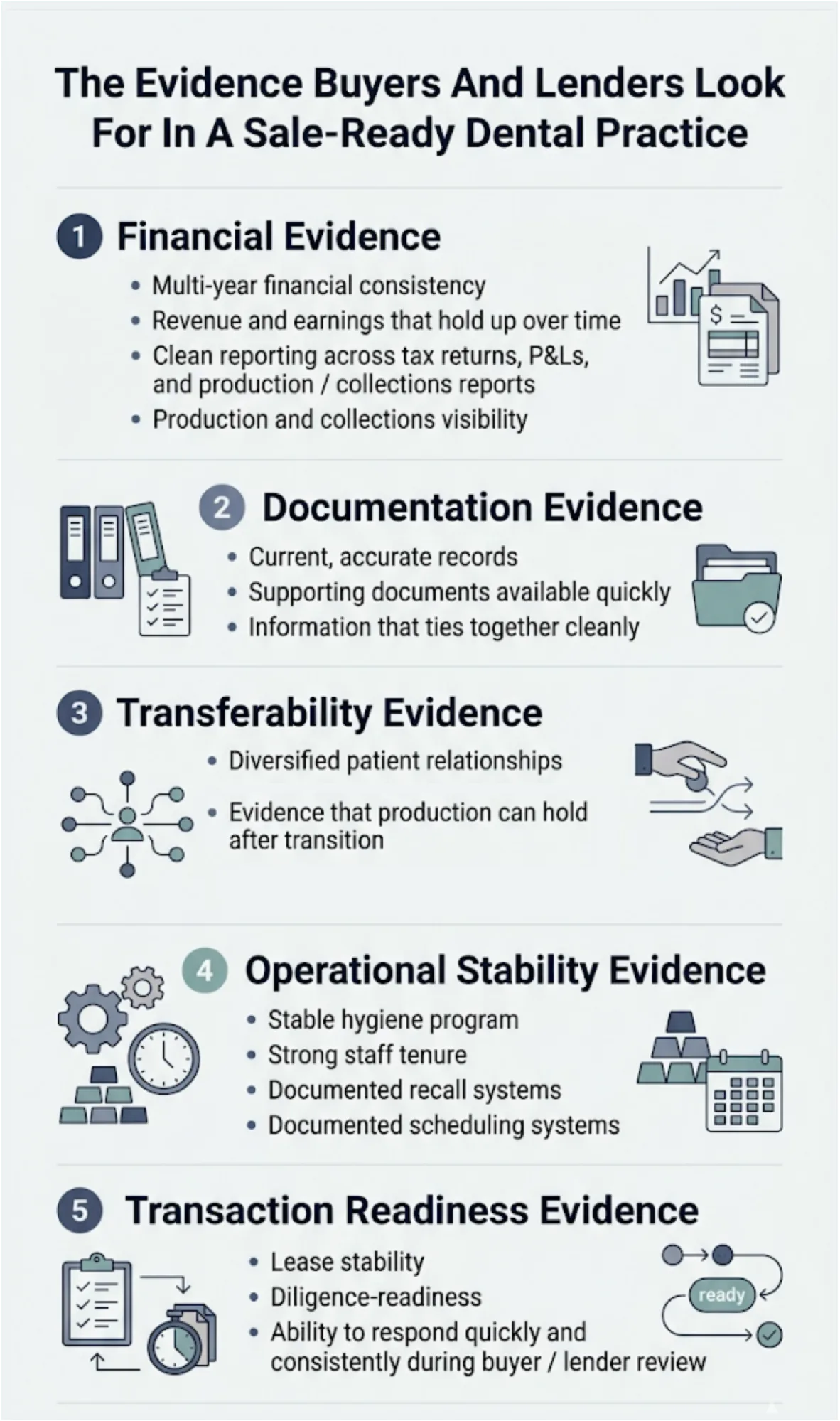
If a seller wants to know whether the practice is truly ready, the most useful place to look is not the asking price. It is the quality of the proof behind the business.
Financial Consistency
Multi-year performance matters more than a single peak year. Buyers and lenders want to see revenue and earnings that are understandable over time, with changes that can be explained without strain. Clean reporting means the practice tells the same story across tax returns, internal financial statements, and production and collections reporting. A defensible financial story is believable, aligned, and easy to support.
Documentation
Strong numbers lose value quickly when they cannot be backed up efficiently. Readiness does not require a seller to share every detail at once, but it does require the ability to produce current, accurate information quickly when the transaction starts to move. That includes core financial documents, production and collections visibility, active patient and hygiene data, and supporting material that allows the buyer and lender to verify what has been presented.
Transferability
Buyers and lenders want reasons to believe that revenue will hold after the transition. Signs of that may include a stable hygiene program, strong staff tenure, documented recall and scheduling systems, and diversified patient relationships. Strong practices do not depend on the owner being there. They depend on the team and the systems continuing to operate the same way after the owner is gone.
Lease Quality
A practice may perform well and still face preventable friction if the location cannot be controlled with confidence after closing. Stable economics matter, but so does a stable place to operate.
Diligence-Readiness
When a seller can answer questions quickly with consistent documentation, the process feels confirmatory. When information is slow, incomplete, or contradictory, diligence becomes investigative. That difference affects momentum, trust, and leverage.
When to Delay a Sale and Use the Time Strategically
Not every practice that can sell is ready to sell well.
There is a buyer for nearly every type of practice, including ones with inconsistent performance, margin pressure, or unresolved transition risk. The real question is whether the seller is positioned to achieve full value with reasonable structure and limited friction, or whether value will be given up through discounts, concessions, or a narrower buyer pool.
The clearest signs that waiting may improve the outcome are usually structural. Financial reporting may be messy. Staffing may feel unsettled. Documentation may be weak. The lease may need attention. None of those issues automatically prevents a sale. But they often weaken the terms on which the sale happens.
Remove obvious friction in reporting, documentation, and lease readiness. Surface what is likely to break under diligence or underwriting before the market sees it. Improve clarity and responsiveness.
Build more credible trend lines buyers and lenders can trust. Make recent improvements look structural rather than transitional. Strengthen consistency and reduce uncertainty.
Improve how the practice is fundamentally perceived under buyer and lender scrutiny. Reduce owner dependence and strengthen transferability. Create durable evidence that performance can hold after transition.
Waiting only helps when it reduces uncertainty. Time by itself does not make a practice more sale-ready. It becomes valuable when it makes the business more predictable, more defensible, and easier to underwrite.
Selling a Dental Practice From Strength
Selling from strength means going to market with a practice that can withstand scrutiny without having to negotiate around preventable weakness. That strength shows up first as leverage. When the practice is well prepared, buyers compete for the opportunity rather than spending the process negotiating around missing information or avoidable risk. It shows up as optionality. The seller has more than one credible path to closing and is not forced to rely on a single buyer or a fragile financing story. And it shows up as underwriting confidence. The deal works on current performance. It does not depend on ideal assumptions or future improvement to justify the structure.
Knowing whether a practice is truly sale-ready changes the seller's position at every stage. Before the LOI, it strengthens the quality of offers. During diligence, it reduces surprises and retrading. During financing, it helps the structure hold together instead of being weakened by unanswered questions.
Uncertainty does the opposite. It gives buyers room to slow down, renegotiate, or ask for more protection once the seller has fewer alternatives.
That is why sale-readiness is not a status but an advantage.
Most practices can sell. Far fewer are positioned to close cleanly, at full value, with strong leverage from the first conversation through closing. The point of assessing readiness early is not to force a sale. It is to make sure that when the time comes, the seller understands exactly where the practice stands and whether the market is likely to confirm that strength or challenge it.
The Bottom Line
The best time to find out how a buyer and lender will judge the practice is before you need the transaction to happen.
Ready to find out where your practice stands?
Get a free, transaction-focused estimate of your practice value in minutes — built to reflect what buyers and lenders actually evaluate.
Value Your Practice
About the Author
Andrea Berk is an entrepreneur and business strategist specializing in dental practice growth, operations, and practice transitions. She is the Founder of The Dental Shop, where she works closely with dentists at every stage of their careers to help them make smarter decisions around buying, selling, scaling, and optimizing their practices. Andrea brings a practical, real-world perspective to complex business challenges facing dental professionals today. Her work focuses on helping practice owners increase efficiency, improve profitability, and build long-term enterprise value—without losing sight of patient care or work-life balance. Andrea regularly publishes insights on dental practice management, business strategy for dentists, practice transitions, and entrepreneurship, offering actionable guidance designed to help owners navigate growth with clarity and confidence. When she’s not advising practice owners, Andrea is focused on building scalable systems and partnerships that elevate independent dental practices nationwide.