What Is a Letter of Intent (LOI) in a Dental Practice Sale?
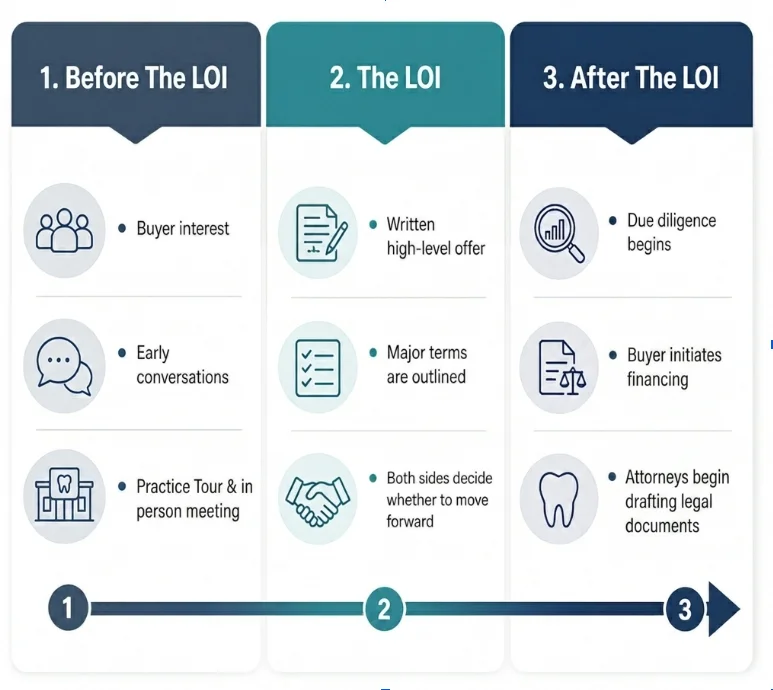
Table of Contents
A Letter of Intent, or LOI, is one of the first documents that makes a dental practice sale feel real.
By the time an LOI shows up, the buyer and seller have usually already had meaningful conversations. The buyer may have reviewed early information, visited the practice, and decided the opportunity is worth pursuing. The seller, in turn, has enough confidence in the conversation to consider taking the next step.
In simple terms, the LOI is the buyer's written offer at a high level. It is not the final purchase agreement. It is the document that helps both sides decide whether they are aligned enough to move into the next phase of the transaction.
That is what makes the LOI important in a dental practice sale. It is often short. It is usually preliminary. But it is the point where a general conversation starts becoming an organized process.
For many owners, that moment is more than procedural. It can be exciting, validating, and emotionally significant because the practice they spent years building is now being considered in a serious way.
What a Letter of Intent Is in a Dental Practice Sale
An LOI is a written summary of the main business terms a buyer is proposing for the acquisition of a dental practice.
In most cases, it is not meant to be a fully negotiated legal contract. Instead, it gives both sides a shared framework before attorneys begin drafting the full purchase documents. It helps answer a basic question: are we aligned enough on the key points to move forward?
Key Insight The LOI sits between early interest and final legal documentation. It is more serious than a verbal conversation, but far less rigid than the definitive sale agreement.
For many sellers, that middle position can be confusing. The LOI is not the final contract, so it can seem informal. At the same time, it is the first document that usually puts the proposed deal in writing and creates a clear path for what happens next.
When an LOI Shows Up in the Sale Process
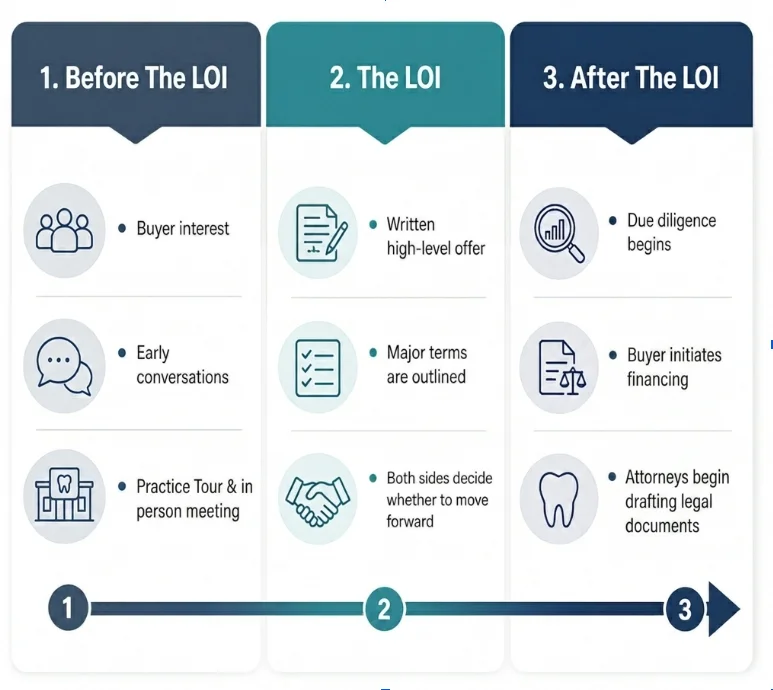
An LOI usually appears after initial interest has turned into a serious discussion. In a typical dental practice sale, the sequence looks something like this:
From there, the transaction moves into deeper due diligence, financing work, legal drafting, and closing preparation.
So the LOI does not show up at the very beginning of the process, and it does not show up at the very end either. It usually appears at the point where both sides want to stop speaking in general terms and start working from a written proposal.
If you are looking at the broader sale timeline, this is the stage where early interest starts becoming a transaction process rather than just a promising conversation. Seeing the LOI in the context of the broader dental practice sale process helps clarify why it appears at this stage and what it starts.
What a Dental Practice LOI Usually Includes
Most dental practice LOIs are high-level documents. They are usually meant to capture the broad outline of the proposed deal, not every legal or financial detail that will appear later.
A typical LOI may include:
Not every LOI will look exactly the same. Some are shorter and simpler. Some include more structure around process and timing. Some buyers may add provisions around confidentiality or other transaction mechanics. But in most dental transitions, the LOI is still a relatively high-level offer document.
Sellers sometimes expect the LOI to answer every question. Usually, it does not. Its role is to capture the major points clearly enough for both sides to decide whether the transaction should keep moving.
Is an LOI a Binding Contract in a Dental Practice Sale?
Usually, an LOI is mostly non-binding. In dental practice sales, that is normal and expected.
The reason is straightforward. Dental practice sales involve a meaningful amount of goodwill, transition planning, and relationship-driven value, so both sides still need time to confirm that the transaction makes sense. The buyer may still need to complete due diligence, work with lenders, and validate the practice in more detail. The seller may still want comfort that the buyer is the right fit and can realistically complete the purchase.
A non-binding LOI usually means signing does not by itself obligate both sides to complete the sale no matter what happens next. That said, some provisions in an LOI can still carry real weight. Confidentiality terms, exclusivity terms, or process-related commitments may be binding even if the sale itself is not yet final. The exact effect depends on how the LOI is written and reviewed.
The practical takeaway is simple: non-binding does not mean unimportant. It usually means the parties are creating a framework to move forward while preserving room to confirm the deal through diligence, financing, and final documentation.
Why Buyers and Sellers Sign an LOI
B For the Buyer
The LOI is a way to present a serious offer and define the basic structure of the opportunity they want to pursue. It creates a structured path to move the acquisition forward.
S For the Seller
The LOI is a way to see that offer in writing and decide whether the terms are strong enough to justify moving into the next stage. It gives a clear view of what is being proposed.
That is the practical value of the document. It gives both sides something more concrete than conversation but less rigid than the final contract. It helps create alignment before more time, effort, and professional cost go into the transaction.
In that sense, the LOI is useful for both parties. The buyer gets a structured way to move the acquisition forward. The seller gets a clear view of what is being proposed and whether it is worth continuing with that buyer.
What Happens After the LOI Is Signed
Once an LOI is signed, the transaction usually becomes more active and more organized. This is the stage where due diligence begins. The buyer moves from a general understanding of the opportunity into a closer, more structured review of the practice's financial records, operations, and documentation.
At the same time, lenders, attorneys, brokers, accountants, and other advisors may become more involved. The process starts moving from broad interest into actual execution.
Key Insight In many deals, exclusivity begins after the LOI. The seller pauses wider market discussions while one buyer evaluates the practice and tries to complete the transaction.
That is why responsiveness and organization matter so much after the LOI. When information is consistent, records are well organized, and both sides stay coordinated, the process tends to move more smoothly. When information is delayed or inconsistent, the process can slow down and become more difficult than it needs to be.
This is also where expectations sometimes evolve. The parties may begin with a rough transition plan in mind, but underwriting or diligence may show that the original version needs to be adjusted. That does not necessarily mean something has gone wrong. It means the transaction is moving from a high-level proposal into a more fully tested structure.
Why the LOI Still Deserves Careful Review
Even though the LOI is usually high-level, it still deserves careful attention before it is signed. The main reason is that it shapes the next phase of the transaction. It may influence timing, exclusivity, transition expectations, and the general path both sides will now follow. Price is important, but it is not the only thing worth looking at.
For sellers, it is useful to understand:
There is also a more personal question underneath the document itself: is this the right buyer to move forward with? Once the process becomes more focused around one party, the quality of that fit starts to matter alongside the wording of the LOI. In that sense, choosing who to move forward with is part of protecting the transaction, not just reviewing the document carefully.
For buyers, the same document is also a discipline tool. It helps them define the offer, communicate expectations clearly, and avoid entering diligence with major misunderstandings already in place.
Reviewing the LOI carefully is not about creating fear around the document. It is about understanding what the document starts. A well-structured LOI can create clarity, save time, and improve momentum. A vague or poorly understood one can create confusion later, even if everyone involved begins with good intentions.
A Practical Way to Think About an LOI in a Dental Practice Sale
The best way to think about an LOI is as a bridge between interest and execution.
It is usually the first written version of the buyer's proposed deal. It appears once both sides are serious enough to move beyond conversation. It is generally high-level, usually mostly non-binding, and designed to help the parties move into diligence, financing, and legal drafting with a shared understanding of the basics.
That is why the LOI matters in a dental practice sale. Not because it is the final contract, and not because it needs to contain every detail, but because it is the document that helps turn interest into a real transaction path.
For both buyers and sellers, the goal is not to overcomplicate the LOI. The goal is to understand it well enough to know what is being proposed, what happens next, and whether the process is moving forward on the right foundation with the right fit on both sides.
Know your practice value before you get to the LOI stage
A free valuation gives you a grounded starting point so you can evaluate any offer with confidence.
Value Your Practice
About the Author
Andrea Berk is an entrepreneur and business strategist specializing in dental practice growth, operations, and practice transitions. She is the Founder of The Dental Shop, where she works closely with dentists at every stage of their careers to help them make smarter decisions around buying, selling, scaling, and optimizing their practices. Andrea brings a practical, real-world perspective to complex business challenges facing dental professionals today. Her work focuses on helping practice owners increase efficiency, improve profitability, and build long-term enterprise value—without losing sight of patient care or work-life balance. Andrea regularly publishes insights on dental practice management, business strategy for dentists, practice transitions, and entrepreneurship, offering actionable guidance designed to help owners navigate growth with clarity and confidence. When she’s not advising practice owners, Andrea is focused on building scalable systems and partnerships that elevate independent dental practices nationwide.